
Groundhog Day
Murder is the unlawful killing of a human being with malice aforethought.

It's been awhile since I've posted anything here. Between running a weekly podcast for four straight months, starting a business, and trying to process the constant onslaught on democracy, I've let a few things fall to the wayside. This Groundhog Day I'm trying to fix that by documenting some of my previous analysis of the back-to-back murders carried out by the Department of Homeland Security in Minneapolis.
Video Analysis of Renee Good's Murder
On 7 January 2026, Renee Nicole Macklin Good was fatally shot by a United States Immigration and Customs Enforcement (ICE) agent. The event was met with immediate claims of self-defense and accusations of domestic terrorism by Secretary of Homeland Security, Kristi Noem; the President of the United States, Donald Trump; and DHS spokesperson, Tricia McLaughlin. These claims flew in the face of video evidence which spread virally across the internet demonstrating the ICE agent's repeated violations of DHS policies, and likely murder of a US citizen.
I struggled to make sense of the moment, but I also grew increasingly frustrated by the repetitive display of the videos without the context necessary to allow an average viewer to draw a reasonable conclusion. So, I sought out publicly available footage to perform my own analysis of the events. I narrowed my effort down to a video shared on social media by local journalist Max Nesterak, which offered the clearest view of the events at the time. This video was recorded using OBS Studio to capture the picture-in-picture audio and video in a manner suitable for further analysis.
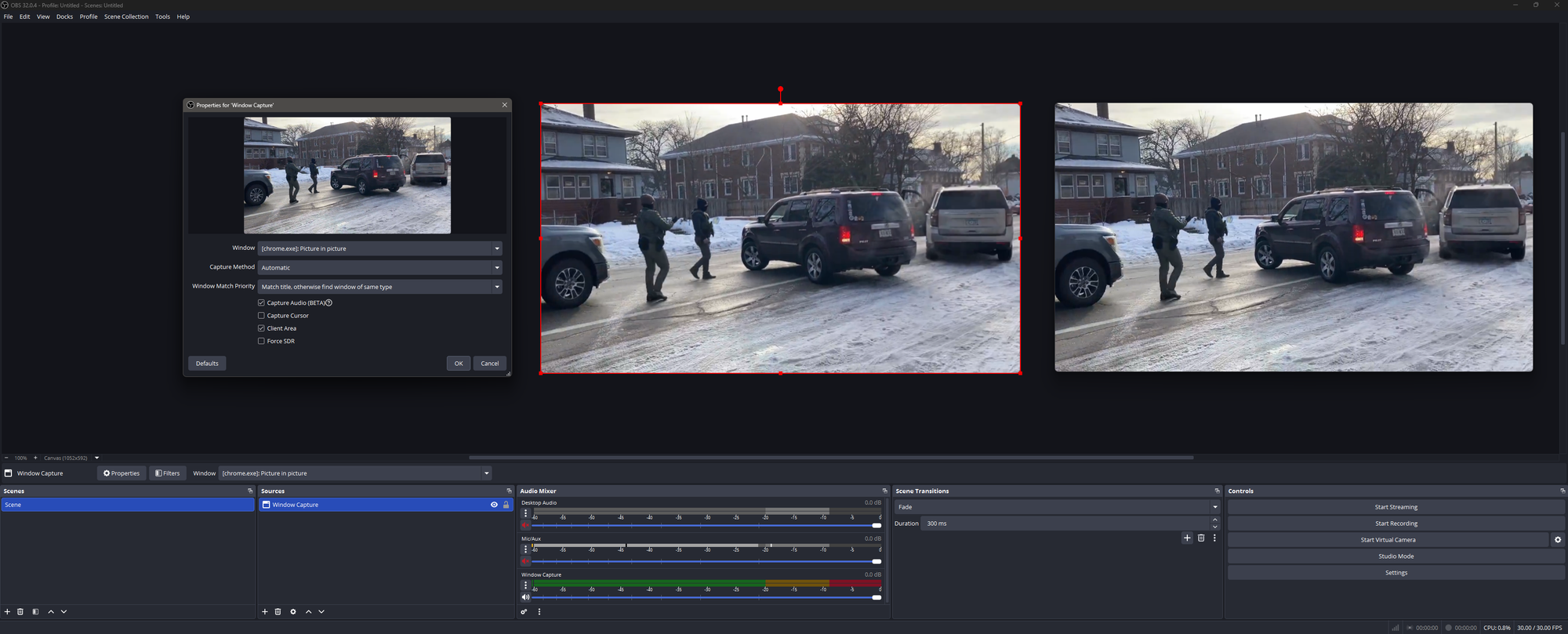
With a local copy of the video, I turned to DaVinci Resolve to allow me to trim the video to the moments surrounding the shooting, slow down the events, and compare the audio and video on a timeline to determine when each shot occurred and whether the ICE agent was indeed in the path of the vehicle when he began firing. NOTE: He was not.
Shot One: Clear of Vehicle, Leans Over Hood
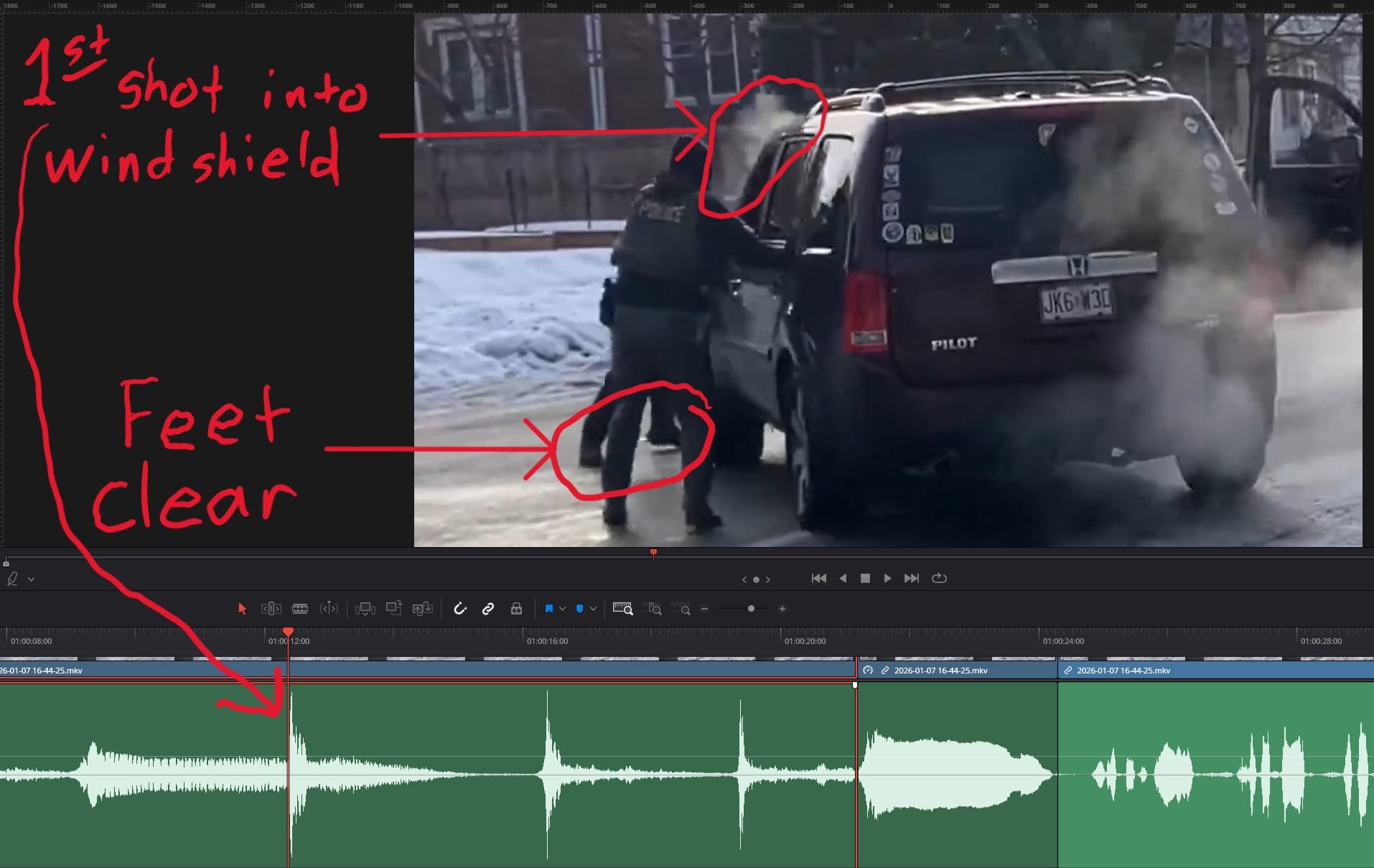
In this frame we can see the moment the first round impacted Good's windshield, as it caused rapid condensation of water vapor into the air. This immediately precedes the moment the cell phone registers the sound of the gunshot. This delay is to be expected as the shot registers visually faster than the sound carries to the phone's mic. The fastest Olympic sprinter traveled less than 41 feet per second; a 9mm round fired at point blank range travels at approximately 1,250. For all intents and purposes, we can assume the shooter's feet did not move significantly between the time the round impacted Good's windshield and the time the trigger was pulled.
As we can see, the shooter's feet are clear of the path of the vehicle, and he can be seen leaning over the hood of the vehicle just before opening fire into the windshield. Nevertheless, the vehicle's tires are pointed away and to the right as it accelerates and the weight of the vehicle can be seen heaving to the left as a result.
NOTE: In a subsequent video released by the shooter on 9 January 2026, Good can be seen from the shooter's vantage point turning the steering wheel away from him as he steps out of the path of the vehicle. It is also noteworthy that in this video the shooter circles Good's vehicle for no apparent reason but to film it with his personal cell phone, then intentionally steps in front of it.
Shot Two: Firing from Safety into Side Window
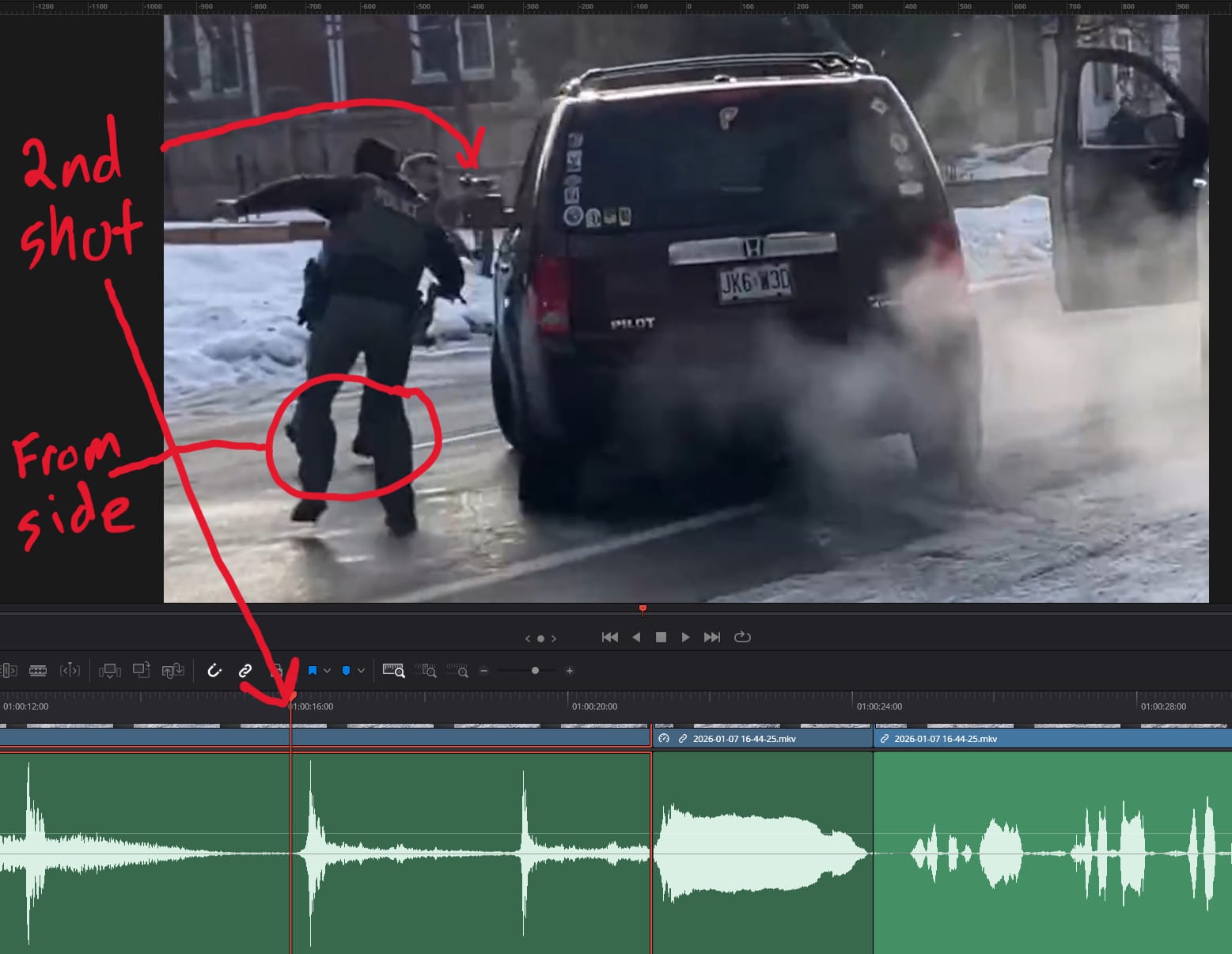
While the agent's first shot through the windshield and his position behind the other agent may have provided some level of doubt to the untrained eye, his subsequent shots remove doubt as to the malice of his actions. In this frame we can see the moment the agent fires the second shot and the slide ejects the round. At the same time, the agent has moved completely to the side of the vehicle into a position that allows him to fire into the open driver's side window.
At this point, it is undeniable that the agent has moved out of harm's way. Having stepped clear; however, he appears to maintain his focus on stopping Good through the use of deadly force in violation of multiple provisions of the DHS Policy on the Use of Force.
Serious Bodily Injury: Physical injury that involves protracted and obvious disfigurement; protracted loss or impairment of the function of a bodily member, organ, or mental faculty; or a substantial risk of death.
NOTE: DHS and the White House attempted to argue the shooter's contact with the vehicle threatened serious bodily injury. There is no evidence the shooter required any medical attention rising to the definition of serious bodily injury, nor were they ever in any obvious danger of incurring such injury.
Shot Three: Firing from Rear, Chasing Vehicle
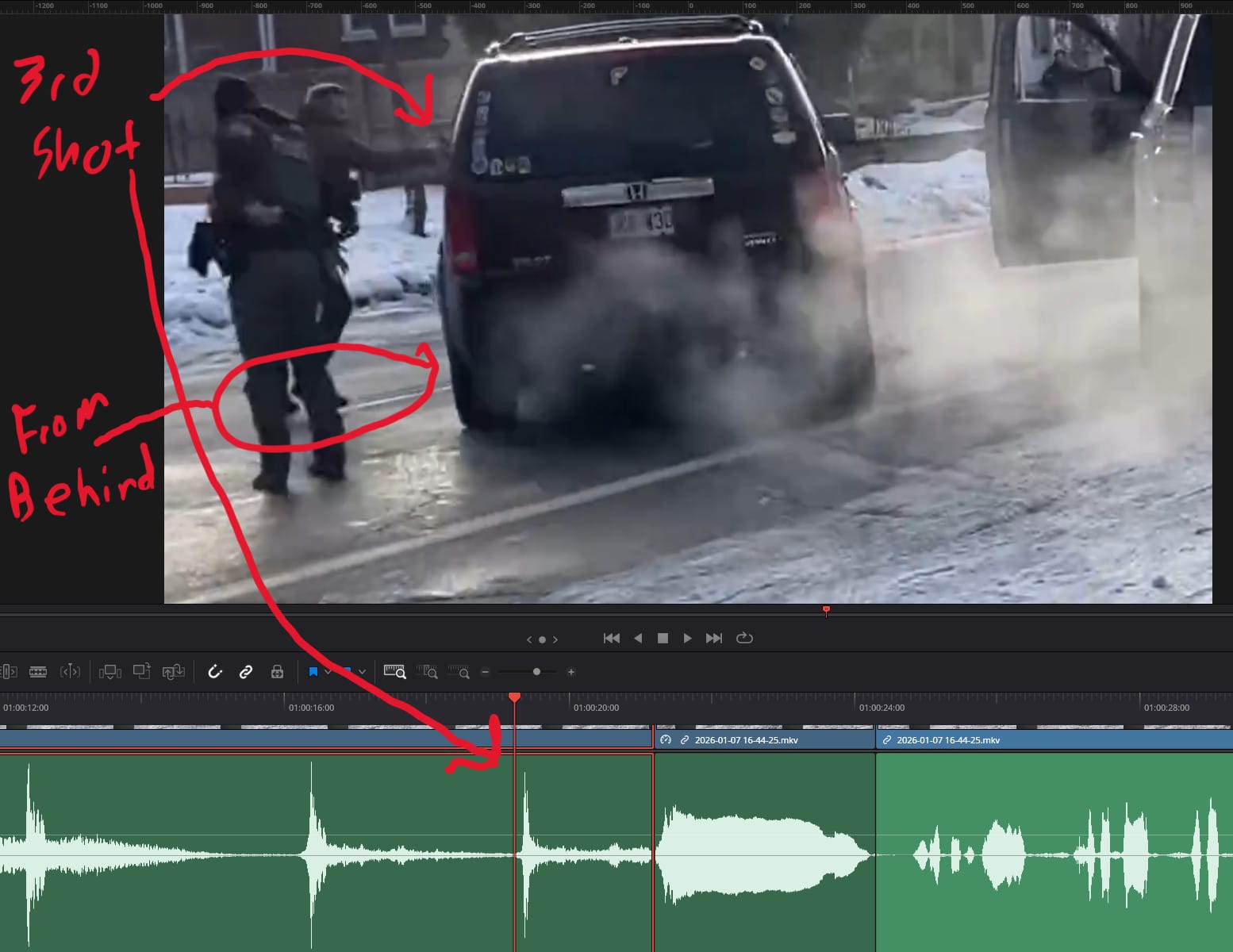
For the removal of doubt, as Good's vehicle passed the clear of the agents, the shooter discharged a third round into her open driver's side window from a rearward angle. He also began moving in the direction of the vehicle as if to chase it. This is quite certainly the most egregious moment of the brief encounter, as the shooter is:
1. In no threat of imminent death or serious bodily injury.
2. Firing at the operator of a moving vehicle without taking into consideration the hazards that may be posed to law enforcement and innocent bystanders by an out-of-control conveyance.
3. Attempting to prevent Good's escape without a reasonable belief that Good continues to pose a significant threat of death or physical harm to himself or others.
For the removal of doubt, I've also uploaded the slowed down video, which was used to generate the above screenshots here.
Watch the video, noting the placement of the shooter's feet and directionality of the tires.
This analysis was initially shared in short form on Bluesky the evening of Good's death. I stand by my initial statement. The shooter's actions resulted in the unlawful killing of a human being with malice. Further, the shooter's continued firing as the vehicle fled may rise to the level of a premeditated act designed to unlawfully and maliciously effect the death of another indicating grounds for pursuit of a first degree murder charge under 18 USC § 1111.
There is no excuse for this. It is murder. The officer was clear of the vehicle before firing the first shot. Fires the second from the side into the driver's open window, and the third is fired from behind into the open driver's window. Don't be gaslit into believing anything else.
— Philip (@hax4libre.com) 2026-01-08T03:52:23.558Z
Bluesky thread from 7 January documenting the above analysis
Video Analysis of the Murder of Alex Pretti
On 24 January 2026 Alex Pretti was fatally shot by two United States Border Protection Officers. Like Renee Good's murder less than three weeks prior, the event was met with immediate false accusations of domestic terrorism by Secretary of Homeland Security, Kristi Noem; the President of the United States, Donald Trump; DHS spokesperson, Tricia McLaughlin; and now former Border Patrol "commander-at-large," Greg Bovino. Feeling like Bill Murray stuck listening to the same alarm day after day, I watched these claims crumble under the weight of overwhelming video evidence that again spread virally across the internet.
While the outcome remained the same—the senseless death of an American citizen at the hands of an unchecked authoritarian takeover—this time was also different. The victim hadn't attempted to escape. There wasn't even the slightest threat of danger to a federal law enforcement officer. There was only video of a pile of agents beating a man that ended with two of them firing repeatedly into his lifeless body. Watching this, I knew I needed to take a harder look.
There are many stabilized versions of this video now, but at the time I was just trying to make sense of the various angles to make tracking the movement of various individuals easier throughout. After downloading or recording videos where available on social media, I used DaVinci Resolve to align and synchronize the tracks.
The first clip is a brief view from moments before the other three begin and shows Pretti engaging with two of the officers—one of whom appears to be Shooter Two, wearing a green shirt, tan cap, and tan backpack, later in the video—while filming. The other is off camera performing crowd control when the shooting occurs.
As the next three clips begin, I've synchronized them based on the distinct audio spike of the first shot across all three angles. I cross-referenced this visually at the 0:43 second mark, matching the moment Shooter Two's left foot hit the ground as he shoved the women Pretti intervened to help. (NOTE: The three videos may be imperceptibly out of sync in the realm of a few hundred milliseconds, as the sound of the first gunshot would likely reach each cell phone's mic at slightly different times based on angle, distance, and surrounding objects.)
As the third video begins and most of the agents enter the skirmish, the first freeze frame marks the moment when Grey Jacket reaches for Pretti's weapon and Shooter One begins to draw his weapon. At this moment Pretti's hands are guarding his head as Shooter Two just finished repeatedly striking him in the head with a container of chemical spray.
In the second freeze frame, as Grey Jacket has secured Pretti's firearm and turned completely away from the skirmish—seemingly directly within view of Shooter One—Shooter One reaches into the skirmish and fires the first shot into Pretti's back. Shooter One continues to fire an additional three rounds into Pretti's back as the remaining agents back out of the way and Pretti falls to the ground.
As Shooter One briefly pauses before freeze frame three, Shooter Two can be seen drawing his firearm. Shooter Two then fires one to two shots into Pretti's lifeless body as he backs away as Shooter One resumes firing four to five additional shots. (NOTE: Due to the angle and quality of the videos, it is not clear whether the shot immediately after Shooter Two's first shot came from Shooter Two or Shooter One. There appear to be ten shots in total.)
Takeaways from my own analysis playing the videos side by side and in sequence. This was another murder. 1. ICE never should have been in this situation 2. No indication victim reached for weapon 3. Grey jacket secured the weapon before 1st shot 4. 2nd shooter was entirely unjustified & excessive
— Philip (@hax4libre.com) 2026-01-25T03:28:32.150Z
Contrary to the claims that Pretti intended to "massacre law enforcement," it's apparent throughout these videos that he attempted to yield to law enforcement. At no point did he reach for his weapon, which was tucked into the back of his waistband and would have made any such effort extremely obvious. When Shooter Two began spraying him with a chemical irritant he raised his hand in the air in surrender and can be heard saying, "Okay, Okay," in deference to his attacker.
As Pretti laid on the ground attempting to protect his head from the repeated strikes of Shooter Two, he was disarmed by Grey Jacket, and then shot repeatedly from behind while unarmed. Shooter One appears to have fired 8-10 rounds into an unarmed man whose biggest crime was attempting to place himself between one of his future executioners and the woman Shooter Two was assaulting.
Applying 18 USC § 1111(a) Murder
In both the case of Renee Good and Alex Pretti, it is important to understand how federal law enforcement officers' actions carried out beyond the limits of a justifiable use of deadly force fit within federal law. In order to properly apply the elements of the federal crime of murder, it is helpful to look beyond the statute and review the Manual of Model Criminal Jury Instructions for the District Courts of the Eighth Circuit.
NOTE: I am not a lawyer, but as a former FBI Intelligence Analyst I have over a decade of experience identifying evidence necessary to prove the elements of a crime in federal courts.
As every circuit has their own unique case law and precedent, this manual is used to apply the statute in plain language so that juries can make accurate decisions based on the facts of the case. First, we establish the elements of the federal crime of Murder in the First Degree for these killings:
1. The defendant unlawfully killed the victim;
2. The defendant did so with malice aforethought as defined within jury instruction 6.18.1111A-1;
3. The killing was premeditated; and,
4. The killing occurred at a location within the court's jurisdiction.
In the case of Alex Pretti and Renee Good, the video evidence has established elements one and four. In order to secure any murder conviction—first or second degree—we move on to malice aforethought.
“Malice aforethought” means an intent, at the time of a killing, willfully to take the life of a human being, or an intent willfully to act in callous and wanton disregard of the consequences to human life.
But “malice aforethought” does not necessarily imply any ill will, spite or hatred towards the individual killed. In determining whether [the victim] was unlawfully killed with malice aforethought, you should consider all the evidence concerning the facts and circumstances preceding, surrounding, and following the killing which tend to shed light upon the question of intent.
It is without a doubt that armed federal law enforcement officers trained in the application of deadly force understood at the time of killing Good and Pretti that they were willfully taking their lives. Further, the continued firing well after any fig leaf of a threat had passed demonstrated callous and wanton disregard of the consequences of human life.
Of note, the jury instructions provide case law examples from United States v. Iron Crow wherein Malice was shown by evidence of conduct which was reckless and wanton and grossly deviated from a reasonable standard of care. The example further referenced violent actions by a defendant against a victim which might have occurred post mortem were relevant to whether the murder was committed with the required malice aforethought. All of the above are pertinent and supported by actions of Good and Pretti's killers.
Finally, in order to secure a conviction of Murder in the First Degree, the killing must have been premeditated. This is arguably the hardest element to prove in a murder involving law enforcement officers. However, it's important to note the amount of time required for premeditation cannot be arbitrarily fixed.
A killing is premeditated when it is intentional and the result of planning or deliberation. The amount of time needed for premeditation of a killing depends on the person and the circumstances. It must be long enough for the defendant, after forming the intent to kill, to be fully conscious of his intent, and to have thought about the killing.
[For there to be premeditation the defendant must think about the taking of a human life before acting. The amount of time required for premeditation cannot be arbitrarily fixed. The time required varies as the minds and temperaments of people differ and according to the surrounding circumstances in which they may be placed. Any interval of time between forming the intent to kill, and acting on that intent, which is long enough for the defendant to be fully conscious and mindful of what he intended and willfully set about to do, is sufficient to justify the finding of premeditation.]
The Eighth Circuit provides the bracketed instruction as an optional inclusion for additional instruction in particular cases. It also provides additional evidentiary factors derived from United States v. Blue Thunder, which may support a determination of premeditation:
1. Facts about how and what the defendant did prior to the actual killing which show he was engaged in activity directed toward the killing, that is, planning activity;
2. Facts about the defendant’s prior relationship and conduct with the victim from which motive may be inferred; and
3. Facts about the nature of the killing from which it may be inferred that the manner of killing was so particular and exacting that the defendant must have intentionally killed according to a preconceived design.
In the case of Renee Good, the ICE agent can be seen moving his cell phone into his non-dominant hand and moving his shooting hand to his holstered weapon before stepping in front of Good's vehicle. It's important to remember that DHS Policy instructs its officers not to place themselves in a position (such as by stepping in front of a running vehicle) that could unnecessarily put them in harm's way. Nonetheless, the shooter did this deliberately with the intent and thought of killing Good demonstrated by his shifting posture prior to taking the risk proscribed by his own policy. This action alone may rise to the level of proving premeditation.
In its absence, Good's shooter may still face life in prison under Second Degree Murder.
In the case of Alex Pretti, Shooter One spent arguably less demonstrable time between when he turned and Grey Jacket removed Pretti's weapon, and when Shooter One opened fire. However, Shooter One also was not under the stress of being near a moving vehicle when he pulled his holstered firearm, stepped around one of his fellow agents for a clear shot, and opened fire into Pretti's back while Pretti laid on the ground. It is hard to argue that Shooter One did not have time to form conscious intent and think about the killing as he postured for a clean opportunity to fire. His continued firing into Pretti's lifeless body may also serve as evidence of the requisite premeditation.
Considerable discussion has occurred regarding whether Shooter Two engaged in "sympathetic fire," which is rooted in the idea that poorly trained officers may open fire in response to stress and gunfire from their peers. This phenomenon is often described as involuntary, and alone may provide Shooter Two a stronger argument for a reduced charge. However, Shooter Two did not simply draw his weapon and fire in response to the action of one of his peers.
Shooter Two instigated the entire cascade of events when he decided to assault a bystander and then turn his anger on Pretti. Shooter Two's actions are arguably the most egregious example of malice aforethought and premeditation among all of the individuals involved. This is most clearly evidenced by Shooter Two's repeated strikes to Pretti's head with a metal canister while Pretti was on the ground—an act itself described as deadly force under the DHS policy.
In this context, Shooter Two's delayed decision to open fire on Pretti appear less like sympathetic fire and more like the calculated deliberation and intent to kill.
The views expressed in this article are solely those of the author and do not necessarily represent the views of the FBI, the DOJ, the United States, or any past or current employers.